Showing posts with label self-publishing. Show all posts

Thursday, September 07, 2017

Marketing your books - BookBot

Hi

There are exciting things happening with Facebook. Recently, they've launched a new product called a Chatbot. It's eary days yet, but the results people are getting are very positive.


What Is a Bot?
"Bot" is a generalized term used to describe any software that automates a task. Chatbots, which anyone can now build into Facebook Messenger, automate conversation -- at least the beginning stages of it."  

https://blog.hubspot.com/marketing/facebook-bots-guide

Authors are getting great results from BookBot Bob.


How does it work?

Bob is a new promo tool with a difference. It does not ask subscribers for an email address. Bob sends readers info about free blurbs + links, and Bookbot Bill sends info about discounted book blurbs + links, both right in Facebook Messenger. Readers decide which genres they want and the boys send them a book in each category. As simple as that. To sign up and check out Bob and Bill’s titles, go to the Bookbot Bob home page and click on the red rectangle that says “Hi Bob!”
FYI, Bob just added an email function for readers who wish to receive discounted pre-order books.
You fill in the form and pay the small amount to book your slot or alternatively, you can support the crowdfunding campaign and get free promos forever.

BOOK BOT IS NOW CLOSED.


Thursday, June 02, 2016

Pre-orders on Smashwords and Amazon

Some of you may wonder what the hype is all about with Pre-orders. 

To put it simply. It's one of the best marketing tools an author has. 

Smashwords - you can list a pre-order up to one year in advance. Then market the hell out of it. One out of eight books on Smashwords is a pre-order and these books do far better in sales than the others.

With Smashwords you don't need to have even written the book. All you need is the basic metadata: title, description, price and categorization. 

On Amazon you can list a pre-order up to up to 90 days prior to the book's launch. On Amazon you need to upload a draft version of your book that is similar to the final version but may need more editing and proofreading. 

Amazon - You can upload a draft version of your cover and update both the cover and interior no less than 10 days prior to launch date. 

Amazon doesn't credit your accumulated pre-orders toward your first day's sales rank. But you already have a sales rank with pre-orders which is a head start on any other book launches on said day.

What you can do when you have listed a pre-order on your retailer of choice: 

  1. Share direct hyperlinks to your book on social media. 
  2. List your pre-order in your existing e-books.
  3. Run price promotions on your other e-books  so you can drive more  readers to your pre-order. 
  4. Organize a marketing campaign to create a buzz around your launch.
  5. Offer your pre-order at a lower price before launch date. Urge consumers to buy now before the launch date when the price will go up.
All the best with your launch.


Friday, April 24, 2015

Writing Great Short Stories


Writing unstoppable fiction:

I came across this...


Short fiction is the "garage band" of science fiction, claims Tor Books editor Patrick Nielsen Hayden, so it's time to step on that fuzzbox and thrash as hard as you can without knocking over your mom's weed-trimmer. Actually, I think Nielsen Hayden was referring to the fact that you can try more crazy experiments in short SF than in novels, because of the shorter time commitment of both writer and reader. But how can you become a super-master of the challenging form of short fiction? Here are a few suggestions.
I wouldn't claim to be an expert on short fiction writing, but I have written over a hundred of the little fuckers, a large proportion of which have been science fiction-y. Here are a bunch of do's and don'ts, that I discovered the hardest way possible.
World-building should be quick and merciless. In a novel, you can spend ten pages explaining how the 29th Galactic Congress established a Peacekeeping Force to regulate the use of interstitial jumpgates, and this Peacekeeping Force evolved over the course of a century to include A.I.s in its command structure, etc. etc. In a short story, you really need to hang your scenery as fast as possible. My friend and mentor d.g.k. goldberg always cited the Heinlein line: "The door dilated," which tells you a lot about the surroundings in three words. Little oblique references to stuff your characters take for granted can go a long way.
Make us believe there's a world beyond your characters' surroundings. Even though you can't spend tons of time on world-building, you have to include enough little touches to make us believe there's stuff we're not seeing. It's like the difference between the fake house-fronts in a cowboy movie and actual houses. We should glimpse little bits of your universe, that don't necessarily relate to your characters' obsessions.
Fuck your characters up. A little. Just like with worldbuilding, you can't necessarily devote pages to your characters' childhoods and what kind of underwear they wear under their boiler suits. Unless your story is really a character study with a bit of a science fiction plot. I used to have a worksheet that included spaces to fill in in info about each character's favorite music, hatiest color, etc. etc. Never filled those out. If I'd tried to force myself to come up with a favorite color for every character, I would have given up writing. But do try to spend a bit of time giving all of your characters some baggage, just enough to make them interesting. Most science fiction readers are interested in characters who solve problems and think positively, but that doesn't mean they can't have some damage.
Dive right in — but don't sign-post your plot in big letters. When I started writing stories, my early efforts meandered around for pages before something happened to one of the characters to make him/her freak out. And then the rest of the story would be the character(s) dealing with that problem. And then, as I got more practiced, I found the foolproof map to awesome storytelling: introduce whatever it was that was freaking out my characters in the very first sentence of the story! And then the story could be about them dealing with that problem, until they solved it in the very end. It was so perfect, how could it fail? It took me another year or two to realize that plunging the characters into the story's main conflict right away was just as boring, in its own way, as the ten pages of wandering in circles. The best short stories I've read are ones which start in the thick of things, but still keep you guessing and let you get to know the characters before you fully comprehend the trouble they're in.
Experiment with form. Short fiction isn't one form, it's a whole bunch of forms jammed together according to their length. Short stories include your standard 3,000 word mini-odyssey thru the psyche. But they also include flash fiction (sometimes defined as under 100 words, sometimes under 500 or even under 1,000.) And those wacky list things that McSweeney's runs sometimes. In fact, for a while there, postmodern short fiction was all about the list, or the footnotes, or the krazy monologue, or the story told in office memos. Try writing super-short stories of only 10 words, or mutant essay-stories written by a fictional person. Also, if you always write third person, try first person. Or if you're always doing first person, try third.
Think beyond genre. Often the best genre fiction is the stuff that cross-germinates. Pretend you're actually writing your story for the New Yorker, and try to channel George Saunders or even Alice Munro. See how far you can go towards writing a pure lit piece while still including some elements of speculation. Or try writing your story as a romance. Or a mystery. Imagine it as a Sundancey indy movie.
Don't confuse your gimmick with your plot. You may have a great idea for a piece of future technology, or some amazing mutation that turns a whole bunch of people into musicvores who survive by eating your memories of rock concerts. Maybe you have the most original basic premise evar — but that's not your plot. Your plot is how your new widget changes the people in your story, and how it affects their lives. Or what decisions your people make as a result of this new technological breakthrough.
Don't fall into the character-based/plot-based dichotomy. People, especially in writing groups and workshops, will try to categorize stories as based on either plot or character. This is a poisonous idea that will turn you into a cannibalistic freak wearing a belt made out of human spinal cords. There's no such thing as a character-based story or a plot-based story, because every story has both. Even the most incident-free Ploughshares romp or the most twisty thumpy space opera tale. If you start thinking that stories can be categorized into either pile, you'll end up writing either eventless character studies or plot-hammer symphonies starring one-dimensional nothings.

http://www.stumbleupon.com/su/1xesN8/+lyNiP+6:qUcWrlid/io9.com/366707/8-unstoppable-rules-for-writing-killer-short-stories?tag=writing-advice

Thursday, January 08, 2015

Show, Don't Tell, on Twitter


I just found this and though I should share:


From the blog of Nicholas C. Rossis, author of science fiction, the Pearseus epic fantasy series and children's books
From blackberryczech.cz
I have often mentioned the “show, don’t tell” rule in my blog. MMJaye, a regular around here and a great supporter of Indies in her own blog, kindly wrote this guest post for me, tackling the rule from a novel perspective: how to use it when tweeting. Enjoy her excellent post, which, I admit, was an eye-opener for me.

“Show not Tell” on Twitter: a guide to “clickable” tweets

The “show don’t tell” rule has been drummed into every writer’s head. Traditional publishers and editors swear by it. Some Indie authors are less than enthusiastic about it, but, no matter how much you use or respect the rule, you have to admit that it does invest your writing with one major attribute: it becomes evocative.
What surprises me, however, is the fact that although writers accept that “show don’t tell” leads to evocative writing and therefore elicits a reaction from the reader, they totally disregard this rule in their promotional tweeting. Sure, 140 characters won’t allow for much but, still, there are ways.

Tweets that tell

Here’s a list of common tweets that “tell” rather than “show”:
  • “The most exciting thriller ever!”
  • “Another 5-star review for (title)!”
  • “You won’t be able to put (title) down!”
  • “Read (title) on Wattpad!”
  • “Don’t miss out! (title) only 99c!!”
Now if you’ve used these tweets yourselves and keep track of your Twitter statistics, you’ve probably noticed they got tons of retweets. Indeed, if you use the right hashtags, have a retweeting service, you are a member of a group or especially if you campaign through Thunderclap, any tweet you hash out (pun intended) will probably be shared with a potential outreach in the tens of thousands.
But what’s your ultimate goal? To get tons of RTs and FAVs or have people actually click on your link and go to your site?
The problem with the tweet templates above is that they’re so overused that what sticks with people is the enthusiasm of the writer. They’ll want to share, to help the author out, but this is not enough to make them leave Twitter and go check out a link. So how do you get tweeps to become more involved and go the extra flick of the wrist to click on a url?

Tweets that “show”

Think “show don’t tell”. Let’s try this on the examples above.

Example 1

Telling tweet: “The most exciting thriller ever!”
Says you. Show me why. “International espionage, exotic locations, action-packed scenes” might do the trick, but why not go all the way and add an actual snippet that will draw a reaction from me?
Showing tweet: “A thick clod of dread thudded onto the pit of his stomach.” The acclaimed new thriller by @JohnnyWho (+link)
Now, you have me! Alliterations, puns, original analogies, evocative words … surely you have those in your book. Don’t tell them … show them off!
I know for a fact that I sold a copy of Fate Accompli, my newly-published debut novel,  through the snippet I have included in my scheduled tweets:
“Staying is a mistake.”
“Why don’t I feel it?”
“You don’t know what’s coming next.”
From the blog of Nicholas C. Rossis, author of science fiction, the Pearseus epic fantasy series and children's books
I chose a sexually charged moment as I’m trying to sell a contemporary romance. That said, try to use actual snippets of your book, even if you need to edit some words out to make them fit. Don’t make them up. Inventive, yes, a fraud, no.

Example 2

Telling tweet: “Another 5-star review!”
Now that’s a bit trickier, but going down the same route, choose a snippet of the review that “shows”. Avoid generic attributes such as “exciting”, “amazing”, “wonderful”. They, too, fall under the “telling” category. I have but a few reviews so far (I expect quite a number in January, yay!), but only a couple of days ago, I received a great review by a book blogger that I wanted to share like gangbusters. That’s the excerpt I chose:
Showing tweet: #FateAccompli
“Gut-wrenching pain, hilarious humor and #romance, neatly packaged against the beauty of Greece.”
ow.ly/FTUCe
That tweet created actual engagement and a lot of reactions. I did have sales the next day but, frankly, there’s no way to know for sure if these were a direct result of the showing tweet. Knowing I did my best, though, makes me feel good!
From the blog of Nicholas C. Rossis, author of science fiction, the Pearseus epic fantasy series and children's books

Example 3

I recently reviewed Rayne Hall’s myth-busting “Why Does My Book Not Sell? 20 Easy Fixes.” What I did for my review tweet was to use an eye-catching phrase from the book itself:
Showing tweet: “An authors’ guide to identifying “the plugs that block sales from gushing”.
Why Does My Book Not Sell?”
http://ow.ly/FKMon  by @RayneHall
That’s a great way to catch the attention of an author that matters to you.You show that you cared enough to be creative about their work.
From the blog of Nicholas C. Rossis, author of science fiction, the Pearseus epic fantasy series and children's books

Example 4: Wattpad tweeting

Wattpad is a good way to make your work visible to readers. Many readers of my genre (romance) find authors through this platform, and I often see writers tweet about adding extra chapters of their books there. But it seems that all they do is notify:
Telling tweet: “Another chapter of (title) on #Wattpad!
When I first posted the first three chapters of Fate Accompli on Wattpad, I tweeted about it by writing a mini summary of what goes on:
Showing tweet: “4 Chapters of #Fate Accompli on #wattpad!
Why is Monica obsessed with working for Alex, hiding who she is?
ow.ly/ExZDN #romance”
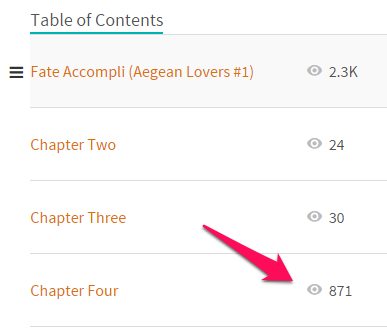
That tweet got tons of RTs, and my uploaded work on Wattpad reached 1,000 views in just under a week. The effect of a well-phrased, intriguing pitch on Twitter was further proven when I uploaded the fourth chapter and tweeted about that exclusively:
Chapter 4 of #FateAccompli on #Wattpad!
Monica revisits her past, featuring Alex and a ton of humiliation!
ow.ly/Fveiz #romance”
Maybe it was the concept of humiliation that drew attention, but that chapter had many more views compared to Chapter 3, which didn’t receive special attention.
From the blog of Nicholas C. Rossis, author of science fiction, the Pearseus epic fantasy series and children's books
Bottom line: we have shed blood, sweat and tears to hone our craft, and we have the right tools under our belt (no pun intended this time!). Why not use them on every form of writing, not least our platform building through which readers will get to know us first?

Example 5

Rachel Thompson (@RachelintheOC) has been using this technique even before publishing Broken Places, the follow-up to her bestselling Broken Pieces.
Showing tweet: “It’s only in the quiet spaces between our stars that I feel you now” ~ Night (Broken Places) out soon http://ow.ly/FSh3I”
And where can a link of unpublished work take the reader? To Rachel’s Poetry Pinterest board with even more quotes of the upcoming book. There’s an idea!
From the blog of Nicholas C. Rossis, author of science fiction, the Pearseus epic fantasy series and children's books

Example 6

When Nicholas told me that he wanted to tweet about Runaway Smile, I suggested the following:
“An unshared smile is a wasted smile: read Runaway Smile, my #free children’s #book, on http://bit.ly/1xqb4Jv”
I’m delighted to see he is now smoothly employing this technique in his tweets about his heartwarming children’s story!
Thank you for reading and special thanks to Nicholas for hosting me today!

Who is MMJaye?

From the blog of Nicholas C. Rossis, author of science fiction, the Pearseus epic fantasy series and children's booksMM Jaye is the pen name of Maria Messini, a bilingual Greek native.  She is a certified translator and has been teaching the art of translation for over fifteen years. Writing was Maria’s idea of therapy when, back in 2009, her spirits had temporarily nosedived. Fate Accompli  is her debut contemporary romance, the first book in the Aegean Lovers series, available in two heat versions: Clean & Spicy. She lives in Athens, Greece with her husband, daughter and Kindle.
Maria blogs at MM Jaye writes. You can also find her on FacebookTwitter andPinterest.
Thank you, Maria, for your eye-opening post. Readers, I just read her book,Fate Accompli, and I’m amazed at her skill. I found myself skimming through the book in order to find out what happens next, laughing out loud and moaning with frustration with her heroine – and I’m not even a romance reader! You can read my review on Amazon.

Thursday, November 20, 2014

Six tips to bring your book out of the doldrums

More than ever before authors are struggling to make sense of what's happening with ebook publishing and keep up.
When do we get time to write after blogging, facebooking, twittering, etc? We're told you can't get seen and your book purchased if you're not socially marketing yourself.  It's never easy but we must find the time.

I've just read Mark Coker's tips and wanted to share them here.

Six Makeover Tips:  How to Bring a Book Back from the Doldrums 

Makeover Tip #1 – Look at your reviews at Smashwords, Apple, B&N and Amazon.  Ignore the reviews from friends and family, they don’t count.  Average them up.  How many stars are you getting out of five?

Reviews of Never Too Far by
Abbi Glines (Apple iBookstore)
Today, when I look at the top 20 bestsellers at the Apple iBookstore, they’re averaging 4 stars.  On other random days I’ve done this test, they averaged 4.5.  The #1 bestselling book today at Apple is Never Too Far by Abbi Glines (distributed by Smashwords), and it averages 4.5 stars.  Some of the representative comments are, “loved this book,” “Amazing,” “couldn’t put it down,” “couldn’t stop reading,” “such a wonderful story,” “cannot wait for book 3!” and, “this book hasn’t been out 24 hours and yet I read it twice already.”  If you want to be a bestseller, good or good enough is not good enough.  

You need to WOW your reader.  It doesn’t matter if you write romance, mystery or non-fiction, if your book doesn’t move the reader to an emotional extreme, your job isn’t done.  Take the case of my novel, Boob Tube.  It averages around 3.5 stars.  That’s not good enough.  We’re not wowing readers.  My wife and I should probably do a major revision if we want better reviews.  Our sales range from 20 to 40 copies a month.  What if after a revision, we averaged 4.5 stars?  Imagine how that would move the needle on sales.

    What if you don’t have reviews? – This is as big of a problem as poor reviews.  If your book has been out for more than three months and it’s not selling well and you don’t have reviews, I’d set the price to free, at least for a limited time.  What do you have to lose?  Readers aren’t finding you anyway.  That’s the decision we came to with Boob Tube.  For the first two years (2008-2009), Boob Tube sold maybe 20 copies.  It had only one or two reviews.  My wife and I decided to set the price to free for six months.  We got 40,000 downloads, a lot of reviews, and even our first fan mail (yay!).  Then we set the price to $2.99 and it started selling.  Without reviews at the retailers, Goodreads, LibraryThing and elsewhere, few readers will take a chance on you.  FREE helps readers take that chance.

Makeover Tip #2 – Redo your Cover Image.  If your book’s reviews are averaging over four stars, yet the book isn’t selling, your cover is probably the problem.  This was the case last year for Smashwords author R.L. Mathewson.  She was earning fabulous “WOW” reviews from readers, yet she was only selling a few copies a day (even still, a few copies a day is way above average for most authors). Read the interview with R.L. here
When she upgraded her cover images, her books immediately took off and hit the N.Y. Times bestseller list.  Great reviews plus a great cover can make all the difference.  A great cover image makes a promise to the reader.  A poor cover image chases potential readers away.  Does your cover make a promise?

Here’s a quick test, and a challenge:  If you were to strip away the title and author name, does the image tell the reader, “this is the book you’re looking for to experience [the feeling of first love for romance; fear for horror; edge of your seat suspense for thrillers; knowledge for a non-fiction how-to; an inspiring story of personal journey for a memoir, etc].”

Is the cover image professional?  Does it look as good or better than the top-10 sellers in your category or genre?  The human brain is programmed to process imagery faster than written words.  When a reader is browsing book listings, they’re looking to have their attention arrested by something that speaks to them.   Everything else is noise.  Don’t be the noise.

Back to my novel.  A couple bestselling Smashwords authors have told me that the cover of Boob Tube doesn't work.  It took me awhile to come around, but I agree with them now.  The image focuses on breasts, which are an obsessive, almost-debilitating focus for the actresses on daytime television soaps.  We explore this in the book.  Yet to the reader, the image sends conflicting messages.  Is this book erotica, or pornography?  No, of course it’s not, but the reader doesn’t know.  Because the image isn’t resonating with the right promise, we’re probably chasing away readers who would otherwise be drawn to the story.

Makeover Tip #3 – Is your book priced too high?  When a book is priced too high, it makes the book less affordable to the reader. If you're an unknown author, it makes the reader less willing to take a chance on you.  For readers who could afford it, the high price can makes the book less desirable when there are alternative books of equal quality at less cost.  Last year, when we conducted a comprehensive study of the impact of price on unit downloads and gross sales, we found that lower prices moved more unit sales than higher prices (no surprise there).  We found $1.99 and below underperformed in terms of gross sales (unit sales * price).  We found books priced at $2.99 earned slightly more than books priced over $10.00, yet enjoyed six times as many unit sales.

Dollars in your pocket are nice, but over the long term, the greater number of readers is what will drive your fan base and future sales.  If your book is priced over $5.99, and it’s not selling well, experiment with a lower price and see what impact it has.  There’s one other potential advantage of lower prices:  if the reader feels they received a great read for the price, they may be more likely to give you a positive review, and a positive reviews will lead to more readers.

Makeover tip #4 – Look at your sampling to sales conversion ratio.  The Smashwords store has a little-known feature I think is entirely unique in the ebook retailing world:  We tell you how many partial samples were downloaded.  If you click to your Dashboard, you’ll see a column for book sales and a column for downloads.  The download count is a crude metric, but if you understand how it works, you’ll be able to use it as a relatively good tool.  This data is only for sales and downloads in the Smashwords store.

The download data includes both sample downloads and full book downloads for purchased books.  If a customer or sampler downloads in multiple formats (such as epub and mobi), or downloads multiple times, each time will tick the download count higher.  To make the data cleaner, subtract your paid sales from the download count.  Divide your sales at Smashwords.com by the number of downloads.  This will tell you, roughly, what percentage of downloaders actually purchase your book.

When I do the numbers on my priced book, The 10-Minute PR Checklist, I find that approximately 13% of sample downloads lead to sale.  That’s pretty good.  When we last ran the average numbers a couple years ago, we found that site-wide, about 1 in 50 sample downloads led to sale, but when we looked only at books that had actually sold, the number was closer to 1 in 25 (about 4%).  I’ve seen multiple recent bestsellers at Smashwords where the conversion ratio is 50%.  That’s amazing!  Use these numbers as rough guides.  If you have multiple books at Smashwords, you can see how the numbers compare across your list.  Compare with your friends.  If you’ve had 150 sample downloads and zero sales, such as in my Tip 6 example below, it’s fair to say readers are sending you a message.

Makeover Tip #5 – Are you targeting the right audience?  As a writer, you’re never going to satisfy every reader.  That’s okay.  Don’t try.  Readers who love horror novels may not love romance.  Know your target audience, and then make sure your title, book cover, book description, categorization and marketing are all aligned to target that audience with fine-tuned precision.  If you send the wrong messages, you’ll fail to attract the right readers.  Instead, you’ll attract the wrong reader, and the wrong reader will give you poor reviews.  Again, I’ll use my own novel as an example (since I’m not afraid to illustrate my mistakes!).  Early in our novel, a dead body is discovered, so there’s a bit of a mystery about who did it.  It’s a minor plot point, and the book isn’t categorized as mystery.  However, at one time in 2011, our book description played up the mystery surrounding the murder.  For at least one reader, after she read the description she downloaded the book thinking it was a murder mystery.  It’s not.  It’s a book about the dark side of Hollywood celebrity.  

As a result, we disappointed her, and received this one-star review:
“If you want to read about drug use, masochism, naive behavior leading to wrecked lives and truly disgusting eating disorders, this book is for you. If you were looking for a murder mystery, look somewhere else. I got more than 50% into the book and no one was calling the death a murder. So, no investigation, no questions, none of the things that make a book a murder mystery.” 
Following this review, I removed the murder-mystery subplot from the description and focused on the top themes.  So take a fresh look at your description, cover, categorization and marketing and make sure you’re targeting the right reader.  Avoid the temptation to target a broader-than-necessary market.

Makeover Tip #6 – Pride goes before the fall.  It’s tough being a writer.  You pour your heart and soul into your words, and then lay your words bare before the world to judge.  It takes bravery and confidence to publish.   Speaking from personal experience, it’s heartbreaking to receive your first one-star review.  We all get them.  

Over at Amazon, where I have the most reviews, I received this about Boob Tube:
“A total waste of my time. As another reviewer said, the best part was when I decided to stop reading it! If I could give it a minus star, I would.” 
OUCH!  Nothing’s worse than when the reader hates the book so much they don’t even finish it, and then they leave a review like that just to drive the knife deeper.  What if the book got better later?  What if everything started making sense on the next page?  Readers are a fickle bunch.  

To press forward as a writer, we have to decide what we can learn from, and what we can ignore.  Find your strength from your five-star reviews (we have those too!), and carefully find your inspiration about where you might improve from the negative reviews.  I try to learn something from every review, even if I don’t agree with it.  Some writers, after receiving such scathing criticism, might feel inclined to curl up in a fetal position, unpublish their books, and give up.  Never give up!

The opposite response to reader feedback, however, can be equally destructive, and that’s to let pride leave you deaf and dumb to the bread crumb clues your readers are giving you.  If you want to be a successful writer, you have to be willing to listen to the judgment of readers.  Your readers, through their word of mouth, will determine how many other readers you reach.

I think the chat transcript below serves as a good case study in pride (in fact, it was the spark that led me to write this blog post).  The author contacted me on my personal Facebook page.  As much as I try to separate my personal life from my private life - and I discourage Smashwords inquiries over my personal page - at Facebook it’s difficult to divorce the two without coming across as a rude ogre.  If someone messages me, I try to respond.  I omitted his name, country and other details to protect his identity.  I made minor edits for typo fixes or clarity.  Warning: There's not a happy ending.

http://blog.smashwords.com/2013/03/six-tips-to-read-reader-tea-leaves-how.html